On this page
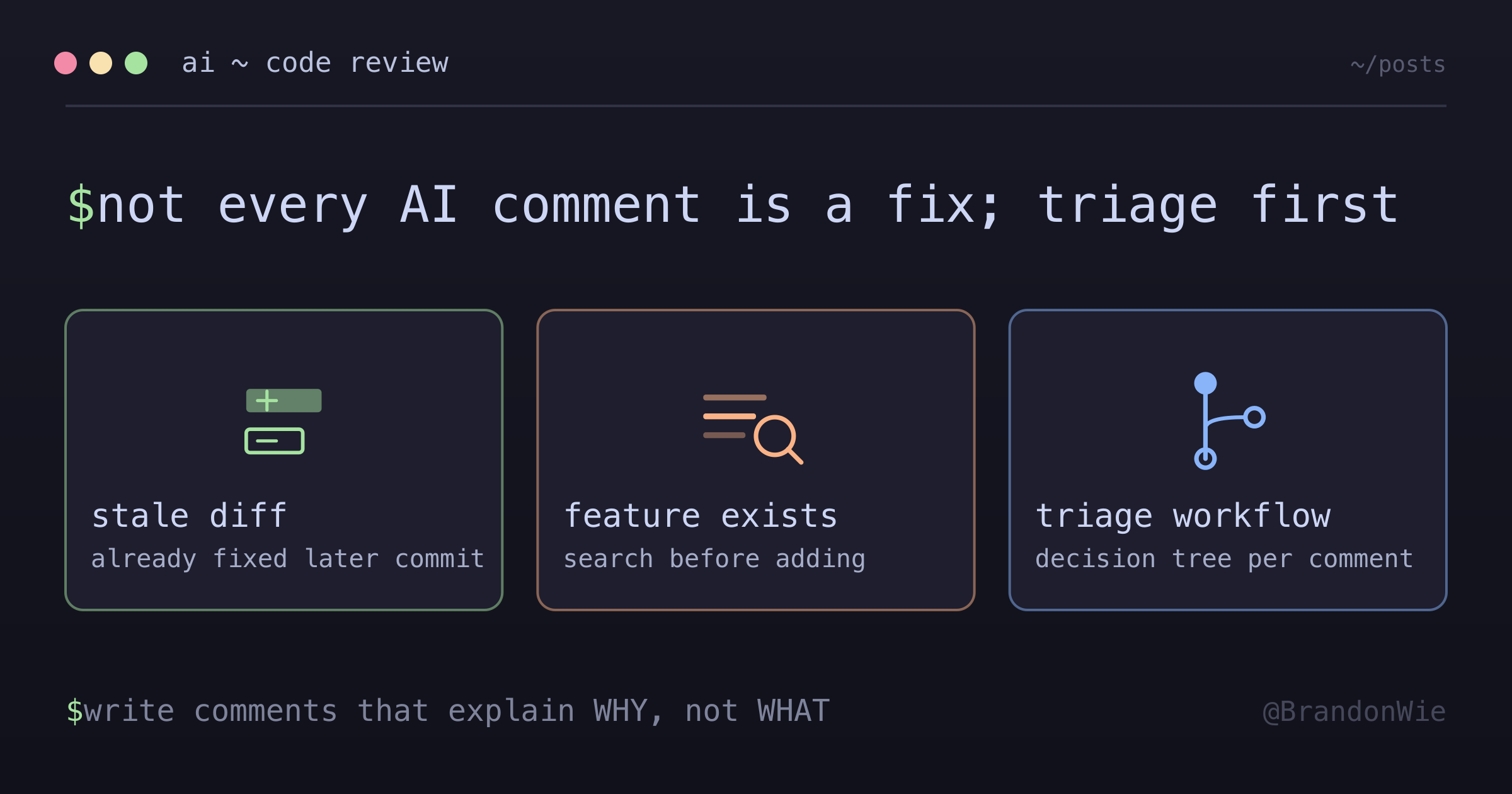
AI Code Review Patterns
Patterns observed when AI reviewers (Claude, Copilot, Codex) generate invalid or misleading feedback, and how to handle each one.
AI code review tools (GitHub Copilot, Claude, Codex) catch real bugs and save time. But they also generate false positives — flagging code that is correct, suggesting features that already exist, or raising concerns about scenarios that cannot happen. After reviewing dozens of AI-generated PR comments across multiple projects, I noticed the same failure modes repeating. This post catalogs six patterns of invalid AI feedback and provides a triage workflow for each.
The Problem
AI reviewers analyze code without full project context. They see diffs in isolation, miss cross-file dependencies, and apply general best practices without evaluating whether those practices apply to your specific situation. The result: a mix of genuinely useful feedback buried under false positives.
Without a systematic way to triage AI reviews, you either waste time implementing unnecessary changes or dismiss everything and miss real issues.
Pattern 1: Stale Diff
Symptom: AI flags code that was already fixed in a later commit.
Example:
AI Review: "Hardcoded account ID '123456789012' should be dynamic"
Reality: Account ID was made dynamic in commit abc123, 2 commits agoCause: AI reviewed an older diff, not the current HEAD. This happens frequently in multi-commit PRs where early commits contain rough code that gets cleaned up in later commits. The AI reviews each diff snapshot independently without checking whether subsequent commits already addressed the issue.
Mitigation:
- Always validate AI reviews against current code before acting
- Re-request review after pushing fixes to get fresh feedback
- Add reinforcing comments explaining the fix was applied (prevents the AI from flagging the same issue again on the next review cycle)
Pattern 2: Feature Exists
Symptom: AI suggests adding a feature that already exists.
Example:
AI Review: "Consider adding checksum verification for the binary download"
Reality: Checksum verification already exists a few dozen lines up in the same fileCause: AI analyzed code in chunks, missing context from other sections of the same file or from imported modules. Token limits force the AI to process large files in windows, and the relevant implementation may fall outside the current window.
Mitigation:
- Point AI to the specific lines where the feature exists
- Add comments near the feature explaining its purpose (helps both AI and human reviewers)
- Use systematic validation to check each review comment against the full codebase before responding
Pattern 3: Cross-File Blindness
Symptom: AI doesn’t see changes in related files.
Example:
AI Review: "entrypoint.sh calls docker-credential-ecr-login but it's not installed"
Reality: Dockerfile installs it, just in a different fileCause: AI reviewed files in isolation without full context. PR review tools typically send each changed file as a separate review unit. If a dependency is satisfied by a different file in the same PR (or an existing file not in the diff), the AI has no way to know.
Mitigation:
- Include all related files in the review context when possible
- Add comments referencing where dependencies come from
(
# Installed in Dockerfile, line 42) - Respond to the review with cross-file references so the AI (and future human reviewers) can see the connection
Pattern 4: Hypothetical Concerns
Symptom: AI raises concerns about scenarios that cannot happen in practice.
Example:
AI Review: "What if AWS_DEFAULT_REGION is set to an invalid region?"
Reality: AWS CLI will fail with a clear error, no special handling neededCause: AI is trained to be thorough, which means it flags every possible failure mode regardless of likelihood. It cannot distinguish between “this could theoretically happen” and “this will happen in production.” The result is defensive programming suggestions for paths that existing infrastructure already handles.
Mitigation:
- Evaluate whether the concern is realistic given your deployment environment
- Trust existing error handling from well-maintained libraries (AWS CLI, database drivers, etc.)
- Only add handling for failure modes that are genuinely likely and whose default error behavior is inadequate
Pattern 5: Intentional Design
Symptom: AI flags code that is intentionally written a certain way.
Example:
AI Review: "The query's start bound, parsed as UTC midnight, misses events for negative-offset timezones"
Reality: a ±1 day timezone buffer intentionally over-fetches — max IANA offset (±14h) < 24h bufferCause: AI sees the mechanism (UTC midnight parsing) but misses the holistic design intent (buffer-based over-fetching). It analyzes line-by-line without understanding the system-level invariant that makes the approach correct. This is the hardest false positive to dismiss because the AI’s reasoning sounds technically plausible — it identifies a real edge case but does not realize the code already accounts for it.
Mitigation:
- Add inline comments explaining WHY the approach is correct, not just WHAT it does
- Document the invariant directly in the code:
// NOTE: ±1 day buffer covers all IANA offsets (max ±14h < 24h) - Reference the design pattern name when applicable (e.g., “over-fetch and filter” strategy)
Pattern 6: YAGNI Suggestion
Symptom: AI recommends premature optimization for a low-traffic or already-constrained path.
Example:
AI Review: "Add partial indexes for the recurrence-start columns"
Reality: an indexed user column plus a NOT NULL filter on the recurrence-parent
column already narrows this to a handful of rowsCause: AI applies general best practices without evaluating the specific data volume and existing filter constraints. It sees a query without an index on a particular column and recommends one, without considering that upstream filters already reduce the result set to a handful of rows.
Mitigation:
- Add a reinforcing comment documenting why the optimization is deferred:
// NOTE: [Optimization] intentionally deferred — current scale does not justify complexity. - Note existing pre-filters that constrain the result set
- If the suggestion has long-term merit, create a backlog item rather than implementing it now — YAGNI does not mean “never,” it means “not yet”
Validation Workflow
When an AI review comment arrives, run through this decision tree before acting on it:
The first two checks (Stale Diff, Feature Exists) are fast — a quick git log or codebase search resolves them in seconds. The Intentional Design check
requires domain knowledge. The final realism check requires judgment about your
specific deployment context.
Key Takeaways
| Pattern | Detection | Action |
|---|---|---|
| Stale Diff | Check current code | Mark invalid, add comment |
| Feature Exists | Search codebase | Point to existing code |
| Cross-File Blindness | Check related files | Explain cross-file context |
| Hypothetical | Assess likelihood | Skip or add minimal handling |
| Intentional Design | Verify design intent/invariant | Add WHY comment at location |
| YAGNI Suggestion | Evaluate actual scale/filters | Document deferral reasoning |
Why This Matters
AI code reviews are a net positive. They catch typos, security issues, and logic errors that humans miss during fatigue. But treating every AI comment as a mandatory fix leads to wasted effort and unnecessary code changes.
The six patterns above account for the majority of false positives I have encountered. Recognizing them lets you triage AI feedback in seconds instead of minutes: check if the code has changed, check if the feature exists, verify whether the design is intentional, assess whether the concern is realistic.
The most effective long-term mitigation is the same across all patterns: write comments that explain WHY, not just WHAT. AI reviewers (and human ones) cannot infer design intent from code alone. A one-line comment explaining the invariant, the pre-filter, or the intentional trade-off prevents the same false positive from surfacing on every future review.