On this page
class-transformer Undefined Own-Property Bug
When `plainToInstance()` creates class instances under ES2022+ TypeScript targets, every optional class field becomes an own property holding `undefined` — and key-presence checks start lying.
I was building a sync-relevance guard that checked which DTO fields the client actually sent, so the service could skip unnecessary Google Calendar API calls. The logic was simple: iterate Object.keys(dto.detail) and see if any Google-relevant fields are present. It worked in unit tests with plain objects. Then I tested it with a real HTTP request, and every single field showed up as “present” — even fields the client never sent. The culprit was class-transformer’s plainToInstance() interacting with a TypeScript compiler change that happened in ES2022.
The Problem
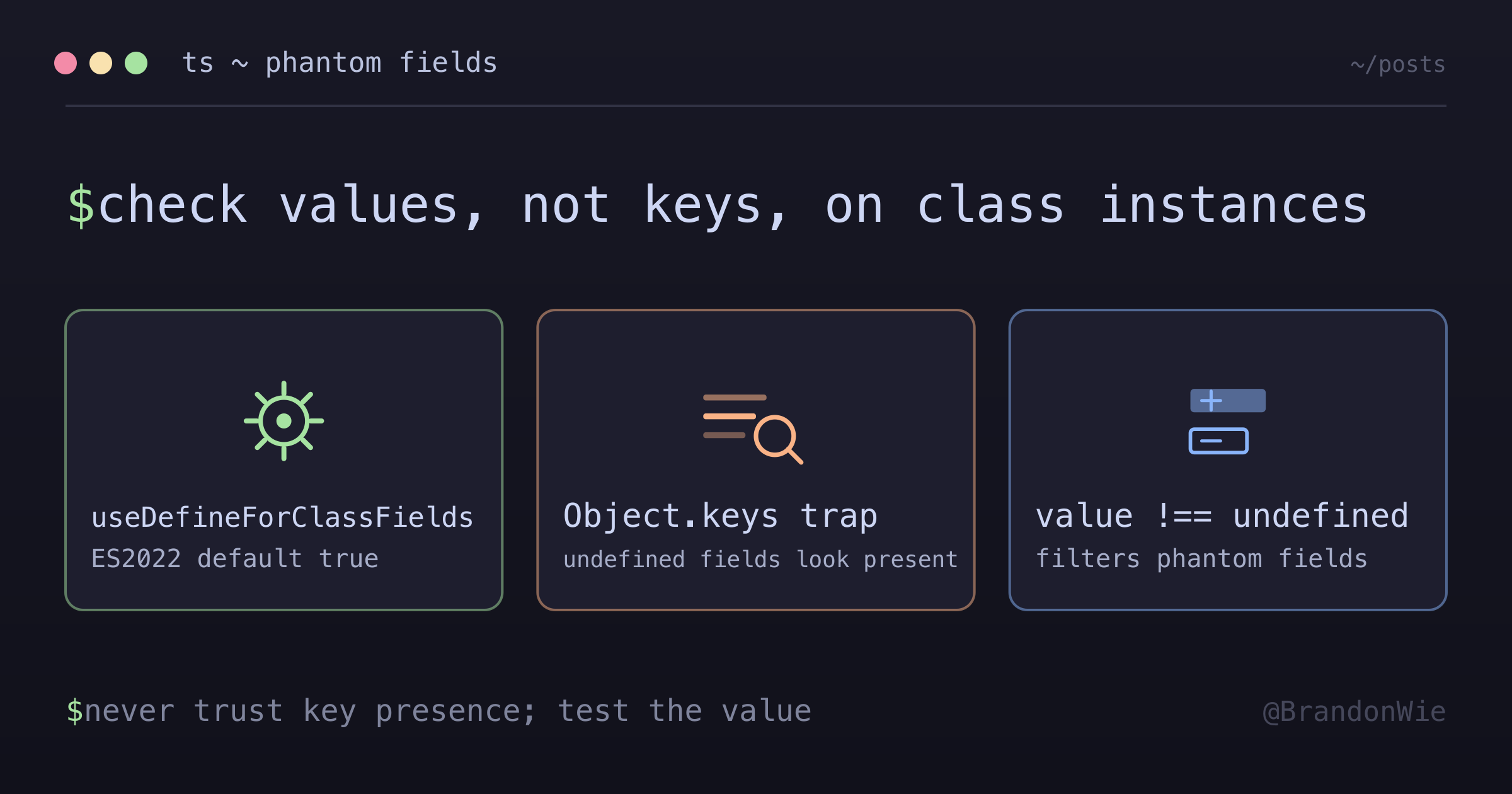
When TypeScript targets ES2022 or later, the useDefineForClassFields compiler option defaults to true. This changes how TypeScript compiles optional class properties — instead of leaving them off the instance, it defines them as own properties with undefined values.
Here’s a self-contained version of the shape I was working with — an update payload whose detail object carries five optional fields:
class EventDetailDto {
  allDay?: boolean;
  title?: string;
  location?: string;
  attendees?: string[];
  hangoutLink?: string;
}

class UpdateEventDto {
  detail?: EventDetailDto;
}
And here’s the chain of events:
tsconfig.json → target: ES2023
  → useDefineForClassFields defaults to true (ES2022+)
  → TypeScript compiles optional properties as class field definitions
  → new EventDetailDto() has all five fields as own properties (= undefined)
  → plainToInstance() preserves these own properties
  → Object.keys(dto.detail) returns all five field names
  → location, attendees, hangoutLink detected as "present" even though undefined
The client sends { detail: { allDay: true, title: 'Standup' } } — only two fields. But Object.keys(dto.detail) returns all five names, including location, attendees, and hangoutLink, because they exist as own properties with undefined values on the class instance.
This is invisible in tsconfig.json because useDefineForClassFields isn’t explicitly set — it’s an implicit default tied to your target version. You can upgrade from ES2021 to ES2022 and break every Object.keys() check on class-transformer instances without touching a single line of application code.
The Solution
The fix is to check value !== undefined, not key presence:
// Before (broken with class-transformer instances)
for (const key of Object.keys(detailRecord)) {
  if (SYNC_RELEVANT_KEYS.has(key)) {
    return true; // False positive! Key exists but value is undefined
  }
}

// After (correct — skips undefined class-field artifacts)
for (const key of Object.keys(detailRecord)) {
  if (SYNC_RELEVANT_KEYS.has(key) && detailRecord[key] !== undefined) {
    return true;
  }
}
Note that null is intentionally not skipped. When a client sends { title: null }, that means “clear this field” — it’s a meaningful change that should be detected. The guard only filters out undefined, which is the phantom value created by class field definitions.
Which Check Methods Are Safe?
Not all property-checking approaches are affected equally:
| Check Method | Safe with class-transformer? | Notes |
|---|---|---|
Object.keys(obj) | No | Returns undefined fields |
key in obj | No | Returns true for undefined fields |
obj.hasOwnProperty(key) | No | Returns true for undefined fields |
obj[key] !== undefined | Yes | Correctly filters phantom fields |
Object.entries(obj).filter(([,v]) => v !== undefined) | Yes | Correct |
Any code that relies on key presence (Object.keys(), in operator, hasOwnProperty()) will produce false positives. Only value-checking approaches (!== undefined) correctly distinguish between “client sent this field” and “TypeScript defined this field as undefined.”
What’s NOT Affected
Functions that already check values rather than key presence are safe. If your code does dto.detail.location === undefined to decide whether a field was sent, that comparison works correctly — it’s testing the value, not the key’s existence.
Plain objects created with {} literals don’t have this issue either. The bug only manifests when plainToInstance() creates class instances, because the class constructor is what defines all fields as own properties.
And if your TypeScript target is below ES2022, useDefineForClassFields defaults to false, so optional properties are never defined as own properties in the first place.
Takeaway
When working with class-transformer on ES2022+ TypeScript targets, never rely on Object.keys() or in to detect which fields the client sent. Always check value !== undefined. This bug is particularly dangerous because it’s triggered by an implicit compiler default — upgrading your TypeScript target from ES2021 to ES2022 silently changes class field behavior, and nothing in your code or config explicitly tells you it happened.