On this page
Don't Retry Retrieval — Diagnose It
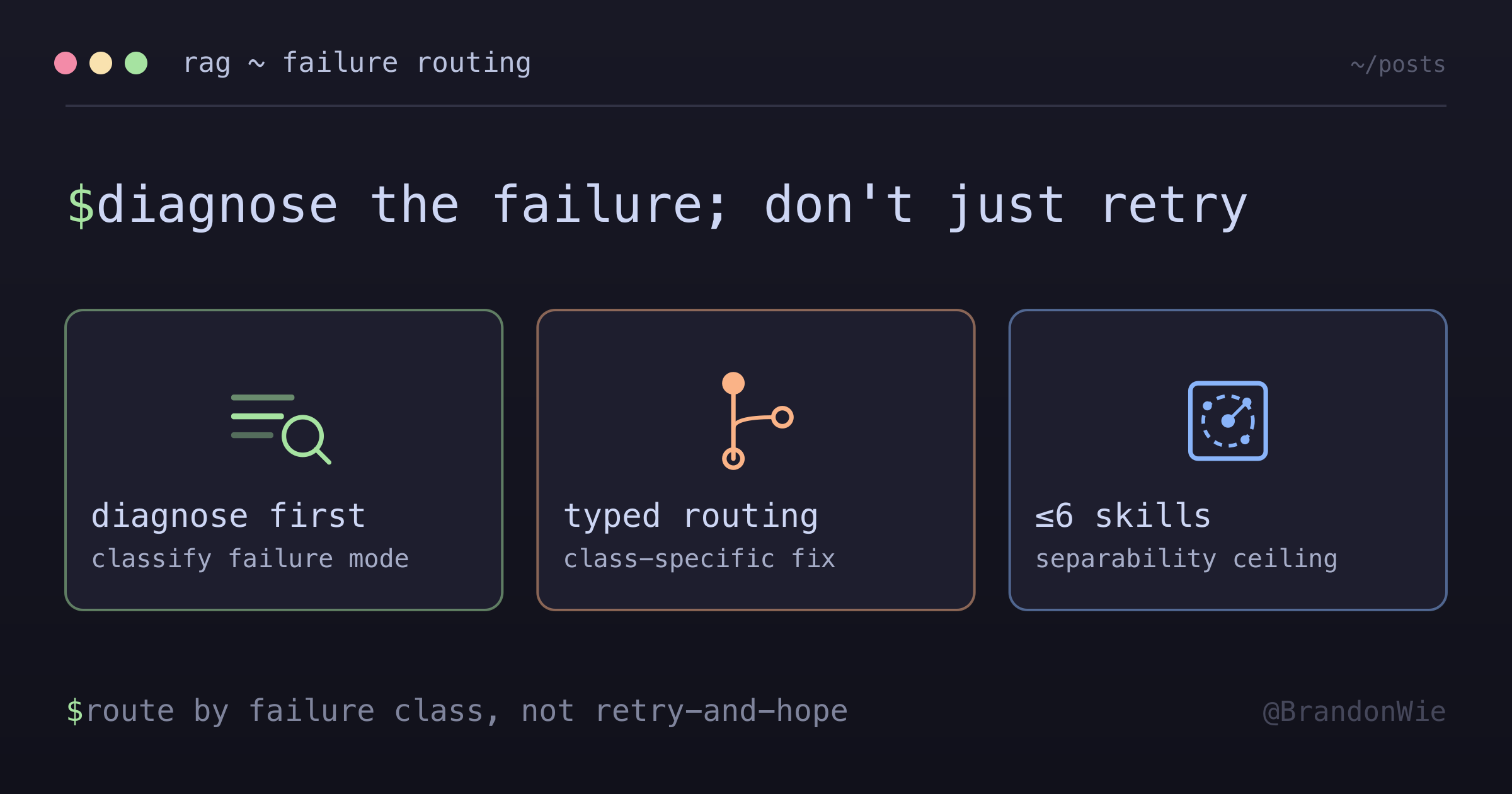
When retrieval comes back weak, the reflex is to retry. Wei et al. (2026) shows retry compounds errors on out-of-distribution queries — diagnose the failure instead.
When a retrieval-augmented system comes back with a weak first result, the next move is almost automatic: retry. Re-issue the query, maybe glue the previous context on, and hope round two lands closer. That reflex feels safe — it’s the same instinct as backoff on a flaky network call. Wei et al. (2026) is the paper that convinced me it’s the wrong default. Naive retry doesn’t just fail to help; on the queries that matter most, it actively destroys the signal you already had.
The trouble lives on the tail
The damage shows up on out-of-distribution (OOD) queries — the unfamiliar, awkwardly phrased, multi-hop questions that make up most of a production RAG system’s tail. In-distribution, where the retriever already works, the choice barely matters. OOD is where retry quietly burns you.
The interesting part isn’t failure detection. Adaptive-RAG systems already detect a weak retrieval. It’s the gap between detecting failure and acting on it. What you do in that gap is the whole game.
How big is the win from getting that gap right? On OOD benchmarks (MuSiQue, 2WikiMultiHopQA), typed routing beats binary gating by +9.85 ACC on average — the mean of MuSiQue’s +6.1 and 2WikiMultiHopQA’s +13.6. In-domain, where the baseline already works, the gain shrinks to +0.8 ACC. The OOD gain is roughly 12× the in-domain gain. Read that as: the harder and stranger your real queries, the more this matters.
This is what I took from the paper — why retry is a trap, what “diagnose instead of retry” actually means, how I adopted it in my own knowledge system, and where the evidence is still thin.
Three traps on the way in
I’ll start with the traps, because each one is a place I could have drawn the wrong conclusion.
1. Retry looks neutral, but it isn’t. The paper’s § 4.4 case study stuck with me. A question about a film’s release date fails round one. The binary-gating baseline builds round two by concatenating prior context — and drifts to “a Japanese rock band,” unrelated to the question. Round three compounds the drift. The retry didn’t just waste a call; it overwrote a round-one signal that was actually closer to correct. Retry isn’t free here. It’s negative.
2. The signal-source misread. The title sells “hidden-state probing,” and it’s easy to walk away thinking you need a neural prober for any of this to work. But the headline table holds the prober constant across the binary-gating baseline and the typed-routing system — same probe, same model. The +9.85 win accrues to routing granularity, what you do after detection, not to the detector itself. That distinction is the most reusable idea in the paper, and the title almost hides it.
3. The taxonomy-size trap. More corrective skills feels safer — surely a richer vocabulary handles more cases? A follow-up t-SNE shows the opposite. Push the vocabulary past about six skills (the paper auto-generates extras with an LLM) and the cluster structure that routing depends on dissolves. The router can’t separate classes it can’t tell apart. Small and crisp beats large and fuzzy.
The reframe: diagnose → route → apply
The change is small to state and large in consequence. Replace this:
if (failed) retry()with this:
diagnose(failure)  → classify the failure mode
route(class)       → pick a class-specific corrective skill
apply()            → re-retrieve, re-probe; loop until success or clean exit
Diagnose the failure class first: is the query too broad? Are the premises entangled? Are the surface forms misaligned? Or is it truly irreducible — no amount of rewriting will help? Then route to a corrective skill scoped to that class, apply it, and re-probe. The loop exits on success or on a clean “give up,” instead of grinding the same primitive.
Wei ships four corrective skills: query rewriting, question decomposition, evidence focusing, and exit. When I adopted the pattern in my own knowledge system, I kept the structure — typed routing — but swapped the signal source. Instead of a hidden-state prober, I route on observable workflow telemetry I already had: empty result sets, repeated greps, broad-hit counts, stale index modification times, privacy-gate denials, tool-error classes. My corpus is closed and well-typed, so those observable signals are enough; I never needed to train a probe.
That adoption became a single routing rule with seven rows — four lifted from the paper, three specific to a multi-layer retrieval corpus:
| Wei 2026 skill | Routing row (my system) | Status |
|---|---|---|
| query rewriting | surface_mismatch (detection-only) | Deferred to index-time aliases: instead |
| question decomposition | entangled_request → decompose | Active |
| evidence focusing | broad_evidence → narrow with missing-slot | Active |
| exit | irreducible exit | Active |
| (unique to my corpus) | tool_layer_mismatch → reroute layer | Active — 5 layered retrieval surfaces |
| (unique to my corpus) | stale_or_private_context (staleness) | Active — mtime-aware indexes |
| (unique to my corpus) | stale_or_private_context (privacy) | Active — privacy gate |
The live rule has since grown past these seven, with extra rows for reasoning-step retrieval and abstraction re-ranking drawn from other papers. The mapping above stays scoped to the Wei-derived set so the comparison is clean.
Why it works
The mechanism is almost obvious once the retry trap is visible. Binary gating has exactly one move after detection — go again — so it can only re-roll the same dice with more context attached, which is how it drifts. Typed routing’s advantage is that each failure class gets a different corrective action, and the round-one signal is preserved instead of overwritten. The gain concentrates on OOD precisely because that’s where the single retry move was most likely to compound rather than recover.
When to reach for this — and when not
Use typed routing when:
- The failure surface has classifiable structure — three or more modes you can name ahead of time.
- Per-class corrective actions are distinct and well-scoped, not just “try harder.”
- Failure-class signals are observable without extra LLM inference cost.
- Hard / OOD cases dominate your real failure population.
Stick with plain retry when:
- Failures are monolithic or unclassifiable — random noise, transient network errors. Retry with backoff is the right tool.
- The vocabulary would be large (>6 corrective skills). Past the separability ceiling, routing becomes guesswork — you’ve recreated the taxonomy-size trap.
- Failure cost is low and retry is cheap. The diagnostic overhead can cost more than it saves.
What I’m still unsure about
I want to be honest about where the evidence stops:
- Cross-model evidence is thin. The headline OOD numbers are Gemma2-9B; the paper mentions additional models, but the big numbers are single-model.
- Domain transfer is unproven — the authors say so. A vocabulary derived from open-domain QA “may not generalize to scientific literature or multilingual corpora.” For a structured corpus (code, schemas, curated notes), aligning at index time — author-declared aliases, for instance — may matter more than rewriting at inference time.
- There’s no observable-signal-only ablation. The paper never isolates plain observable telemetry against the hidden-state prober at equal routing output. So my “you might not need the probe” claim is reasoned, not proven — it’s the open question I’d most like answered.
“Experiments demonstrate substantial improvements on hard cases, with particularly strong OOD gains, highlighting the generalization benefit of structured skill routing over prober gating alone.” — Wei et al. 2026, § 5
The one line to keep
Treat retrieval failure as a diagnostic signal, not a trigger to try harder. Detection was never the hard part — what you do in the gap between detecting failure and acting on it is.
References
- Skill-RAG: Failure-State-Aware Retrieval Augmentation via Hidden-State Probing and Skill Routing — Wei et al. (2026). arxiv.org/abs/2604.15771
- Probing-RAG: Self-Probing to Guide Language Models in Selective Document Retrieval — Baek et al. (2024). arxiv.org/abs/2410.13339