On this page
PostgreSQL Advisory Locks with TypeORM
Application-level locks managed by PostgreSQL for coordination.
I needed to prevent two calendar sync operations from running simultaneously for the same integration. Row-level locks wouldn’t work — there was no shared row to lock on, and the operations spanned multiple tables. PostgreSQL advisory locks were the right fit: application-level locks that live in shared memory, visible across all connections, and automatically released when the connection closes. The catch was making them work correctly with TypeORM’s connection pool.
What Are Advisory Locks?
Unlike row or table locks that PostgreSQL manages automatically, advisory locks are entirely application-controlled. You acquire and release them manually using SQL functions, and PostgreSQL stores them in shared memory rather than tying them to any particular table or row.
| Property | Value |
|---|---|
| Lock ID | bigint (use entity ID like integrationId) |
| Storage | PostgreSQL shared memory |
| Visibility | Across all connections (distributed) |
| Scope | Session-scoped (tied to database connection) |
| Auto-release | Yes, when connection closes |
The SQL interface is straightforward:
-- Acquire (non-blocking, returns true/false immediately)
SELECT pg_try_advisory_lock(123);

-- Release
SELECT pg_advisory_unlock(123);

-- View active locks
SELECT locktype, objid AS lock_id, pid, granted
FROM pg_locks WHERE locktype = 'advisory';

-- See which connection holds a lock
SELECT l.objid, p.pid, p.application_name, p.client_addr
FROM pg_locks l
JOIN pg_stat_activity p ON l.pid = p.pid
WHERE l.locktype = 'advisory';
pg_try_advisory_lock is non-blocking — it returns true if the lock was acquired, false if another session already holds it. This is preferable to pg_advisory_lock (blocking variant) in most application code, because you can fail fast and return a meaningful response instead of hanging indefinitely.
The Critical Rule: Session Scope
The most important thing to understand about advisory locks is that they are session-scoped — tied to the database connection that acquired them. Only that connection can release the lock:
Lock Table:
┌─────────┬─────────────┬─────────┐
│ Lock ID │ Session/PID │ Granted │
├─────────┼─────────────┼─────────┤
│    5    │    1234     │  true   │ ← Only PID 1234 can release
└─────────┴─────────────┴─────────┘
This session-scoping creates a subtle but critical problem when you’re using TypeORM with a connection pool.
The TypeORM Connection Pool Trap
TypeORM’s default dataSource.query() grabs a random connection from the pool for each call. This means your lock acquisition might run on connection A, but your unlock runs on connection B — and connection B can’t release connection A’s lock:
// ❌ BROKEN for advisory locks
await this.dataSource.query("SELECT pg_try_advisory_lock($1)", [id]);
// Gets random connection from pool each time!
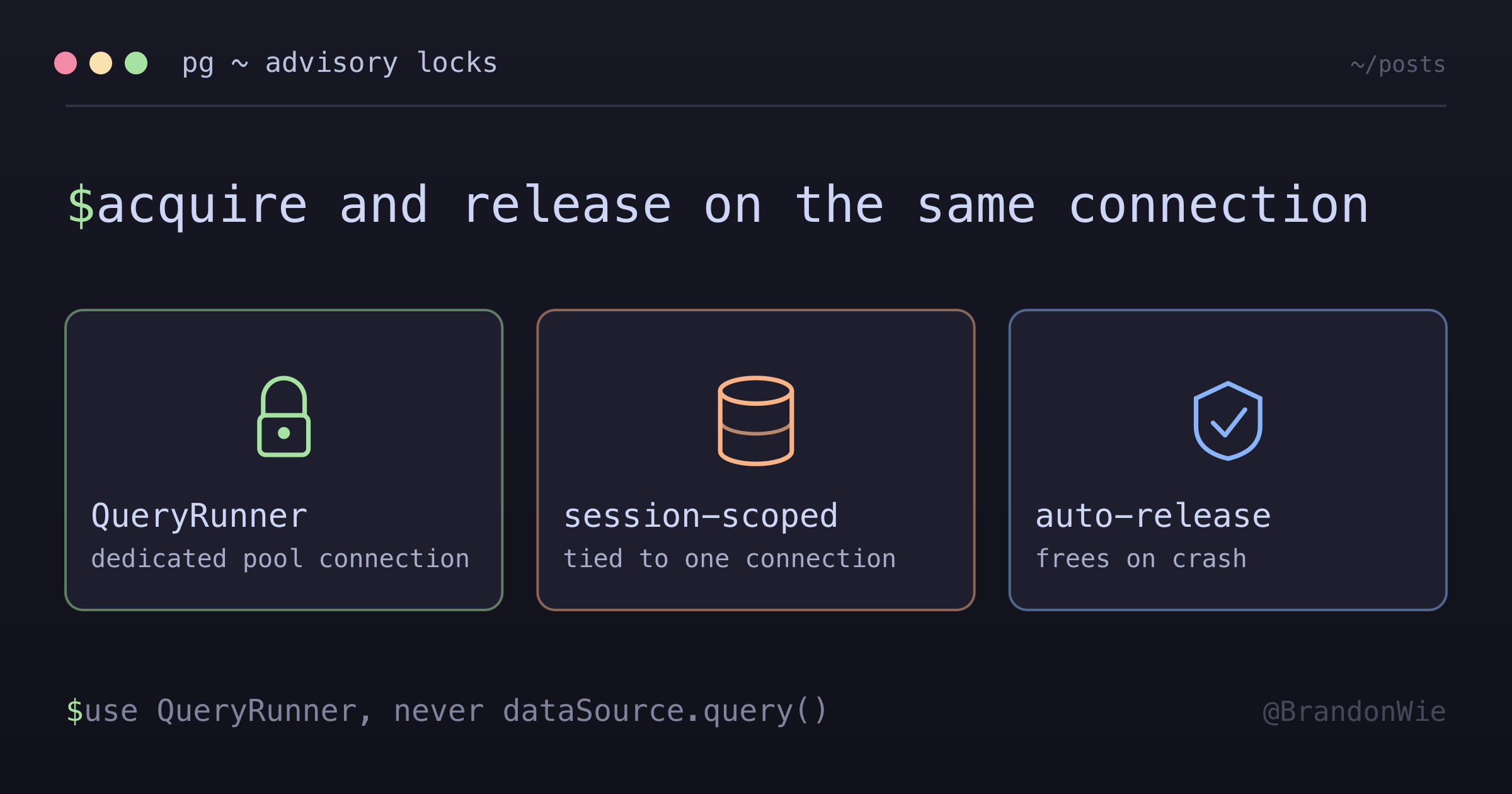
The fix is to use a QueryRunner, which reserves a dedicated connection from the pool:
// ✅ CORRECT for advisory locks
const qr = dataSource.createQueryRunner();
await qr.connect();     // Get dedicated connection
await qr.query(...);    // Always uses same connection
await qr.query(...);    // Still same connection
await qr.release();     // Return to pool
Use QueryRunner any time you need connection affinity: transactions, advisory locks, or any sequence of SQL statements that must run on the same session.
Implementation Pattern
The key design decision is storing the QueryRunner reference so you can release the lock on the same connection that acquired it. A Map<number, QueryRunner> does this cleanly:
@Injectable()
export class LockService {
  private readonly lockConnections = new Map<number, QueryRunner>();

  async acquireLock(id: number): Promise<boolean> {
    const qr = this.dataSource.createQueryRunner();
    await qr.connect();

    const result = await qr.query(
      "SELECT pg_try_advisory_lock($1) as acquired",
      [id]
    );

    if (result[0]?.acquired) {
      this.lockConnections.set(id, qr); // Store for release
      return true;
    }

    await qr.release();
    return false;
  }

  async releaseLock(id: number): Promise<boolean> {
    const qr = this.lockConnections.get(id);
    if (!qr) return false;

    try {
      const result = await qr.query(
        "SELECT pg_advisory_unlock($1) as released",
        [id]
      );
      return result[0]?.released ?? false;
    } finally {
      this.lockConnections.delete(id);
      await qr.release();
    }
  }
}
The finally block ensures the connection is always returned to the pool, even if the unlock query fails. Without this, a failed unlock leaks a connection from the pool — and in a production system with limited pool size, that eventually exhausts all available connections.
Multi-Pod Considerations
In a containerized environment (ECS, Kubernetes), advisory locks work across pods because the lock lives in PostgreSQL, not in application memory:
┌─────────┐      ┌─────────┐      ┌─────────┐
│  Pod A  │      │  Pod B  │      │  Pod C  │
│ Map:{5} │      │ Map:{}  │      │ Map:{}  │
└────┬────┘      └────┬────┘      └────┬────┘
     └────────────────┼────────────────┘
                      ▼
            ┌─────────────────┐
            │   PostgreSQL    │
            │ Lock 5: Pod A   │ ← Source of truth
└─────────────────┘| Scenario | Behavior |
|---|---|
| Pod A syncing, Pod B requests | Pod B’s pg_try_advisory_lock returns false |
| Pod A crashes mid-operation | PostgreSQL auto-releases lock (connection closed) |
| Same pod, concurrent requests | Map ensures one QueryRunner per ID |
The auto-release on disconnect is a critical safety feature. If a pod crashes mid-sync, you don’t need manual intervention to clear the lock — PostgreSQL handles it when the connection drops. This eliminates the need for timeout-based recovery mechanisms.
Is the In-Memory Map a Problem at Scale?
A common concern: “Won’t the in-memory Map cause problems when containers scale horizontally?” The answer is no, because acquire and release happen within the same HTTP request on the same container. The Map tracks which QueryRunner holds which lock during a single request lifecycle. Cross-container coordination is handled entirely by PostgreSQL’s session-scoped locking mechanism — the Map is an implementation detail that never needs to be shared.
Common Pitfalls
- Using
dataSource.query()for locks — gets a random connection each time, breaking the session affinity that advisory locks require - Trying to force-release another session’s lock — impossible by design; only the acquiring connection can release
- Relying on timeouts for recovery — unnecessary, since PostgreSQL auto-releases locks when the connection closes
- Connection pool hiding bugs — with a small pool, you might accidentally reuse the same connection for acquire and release, making broken code appear to work until the pool grows
Takeaway
PostgreSQL advisory locks give you distributed coordination without external infrastructure (Redis, ZooKeeper). The one rule you can’t break: acquire and release must happen on the same database connection. In TypeORM, that means QueryRunner — never dataSource.query(). Store the QueryRunner reference, release it in a finally block, and let PostgreSQL’s auto-release handle crash recovery.