On this page
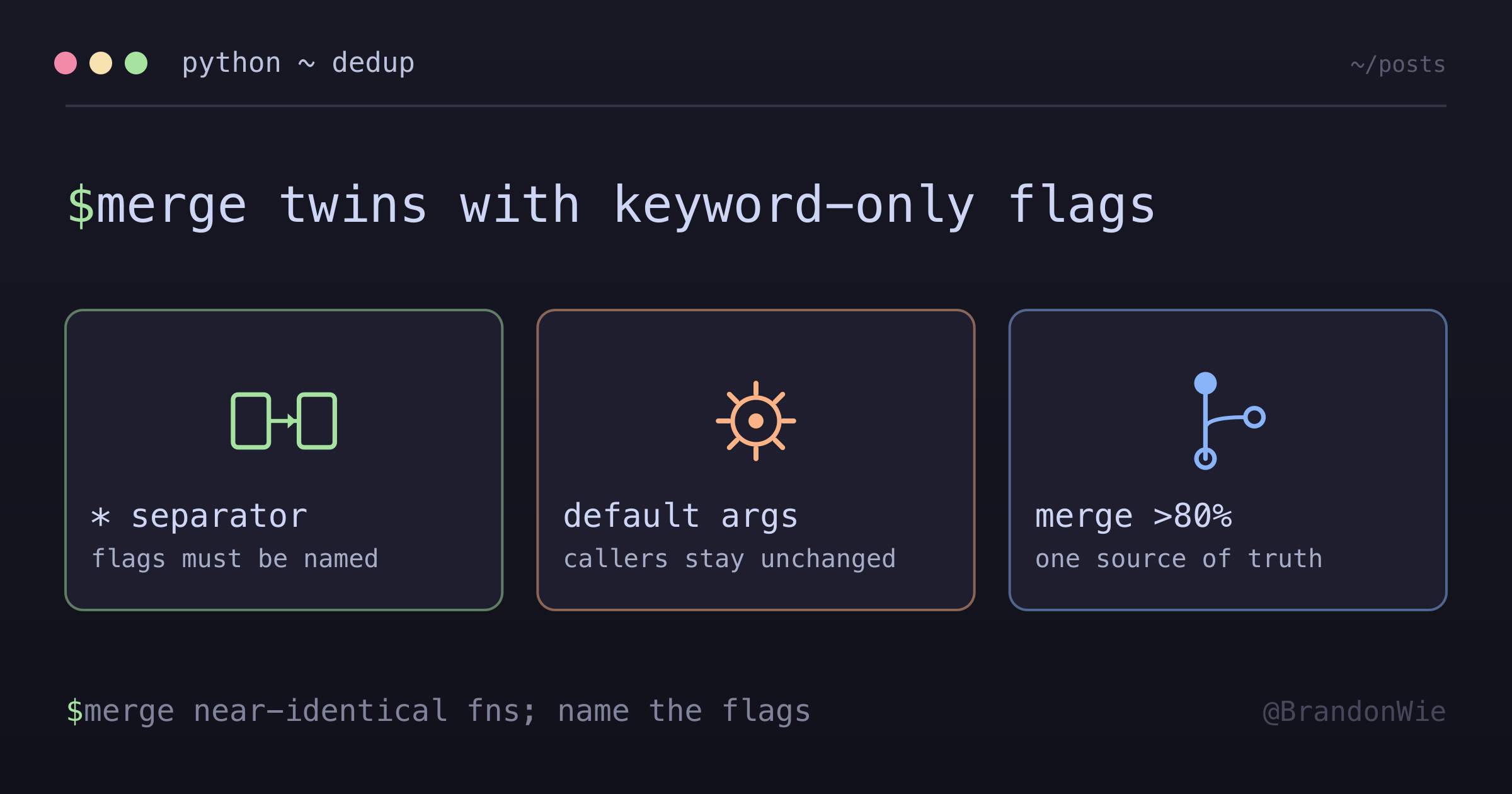
Deduplicating Functions with Keyword-Only Parameters
Two modules contain near-identical functions with slight behavioral differences.
I needed to fix a bug in an ETL pipeline’s S3 upload function and realized the exact same bug existed in a second copy of the function in a different module. One handled regular automated exports, the other manual backfills. They were 90% identical — the only differences were the S3 prefix and whether to extract data from a ZIP archive. Classic copy-paste duplication, and fixing the bug twice was the nudge I needed to merge them.
The Problem
In ETL codebases, it’s common to have a “regular” path and a “backfill” path that do the same thing with slightly different configuration. When these live in separate modules, the duplication is easy to miss — until both need the same fix and you realize you’re maintaining two copies of the same logic:
# BEFORE: Two separate functions in two files

# module_a.py
def save_data(data, date, hour):
    # extracts from zip, saves to prefix "regular"
    with zipfile.ZipFile(io.BytesIO(data)) as zf:
        gzip_data = zf.read(zf.namelist()[0])
    key = f"regular/regular_{date}_{hour}"
    s3.put_object(Body=gzip_data, Key=key)

# module_b.py
def save_data(data, date, hour):
    # saves raw bytes to prefix "backfill"
    key = f"backfill/backfill_{date}_{hour}"
    s3.put_object(Body=data, Key=key)
The behavioral delta was exactly two things: the S3 prefix name and whether to extract from a ZIP before uploading. Everything else — the S3 client calls, error handling, completion marker logic — was identical.
The Solution: Keyword-Only Parameters
Python’s * separator lets you add parameters that callers must name explicitly. This is perfect for behavioral flags — it forces clear intent at the call site while keeping the function signature self-documenting:
# AFTER: Single function with keyword-only params

# common.py
DEFAULT_PREFIX = "regular"

def save_data(
    data: bytes,
    date: str,
    hour: int,
    *,                          # Everything after * is keyword-only
    prefix: str = DEFAULT_PREFIX,
    extract_zip: bool = True,
) -> str | None:
    if extract_zip:
        with zipfile.ZipFile(io.BytesIO(data)) as zf:
            upload_data = zf.read(zf.namelist()[0])
    else:
        upload_data = data

    key = f"{prefix}/{prefix}_{date}_{hour}"
    s3.put_object(Body=upload_data, Key=key)
Why Keyword-Only (the * Separator)
The * separator is the key design choice. It forces callers to name the behavioral parameters explicitly:
# Existing callers work unchanged (use defaults)
save_data(data, date, hour)

# New callers must be explicit about behavior
save_data(data, date, hour, prefix="backfill", extract_zip=False)
Without *, someone could accidentally pass positional arguments:
save_data(data, date, hour, "backfill", False) # Unclear intentReading that call, you’d have no idea what "backfill" and False control without checking the function signature. Keyword-only parameters make the intent visible at every call site.
Choosing the Right Approach
The decision of whether to merge functions depends on how much they share:
| Condition | Action |
|---|---|
| Functions are >80% identical | Merge with params |
| Behavioral diff is 1-3 flags | Use keyword-only params |
| Behavioral diff is structural | Keep separate (different abstractions) |
| Functions are in same module | Probably already should be one function |
| Functions are cross-module | Move to shared module, import from both |
Options I Considered
| Option | Pros | Cons |
|---|---|---|
Keyword-only params (*) | Callers must name flags; defaults preserve compat | Signature grows with each flag |
mode: str enum param | Single param instead of multiple flags | Stringly-typed; no autocomplete; invalid values possible |
| Config dict / dataclass | Groups behavioral config together | Over-engineered for 1-3 flags; caller builds object |
| Keep separate functions | No refactoring needed; self-contained | Bug fixes applied twice; implementations drift |
I chose keyword-only parameters because the behavioral delta was exactly 2 flags, defaults preserve existing caller compatibility with zero changes, and the * separator makes it impossible to pass behavioral flags positionally by accident. The mode: str alternative was rejected because it would require internal dispatch logic and provides no type safety.
When NOT to Merge
Merging isn’t always the right call:
- Structural behavioral differences — if two functions share less than ~80% of their logic, merging creates a function full of conditional branches that’s harder to read than two separate functions
- More than 3 behavioral flags — too many keyword-only params signal the functions are different abstractions; consider the Strategy pattern instead
- Temporary/throwaway code — if one path will be deleted soon (e.g., a one-time backfill), the refactoring effort is wasted
Takeaway
When you find two near-identical functions with 1-3 behavioral differences, merge them using Python’s * separator to add keyword-only parameters for the differences. Set defaults to match the original “primary” path so existing callers don’t need any changes. The result: one source of truth for bug fixes, explicit intent at every call site, and no risk of the two implementations drifting apart.