On this page
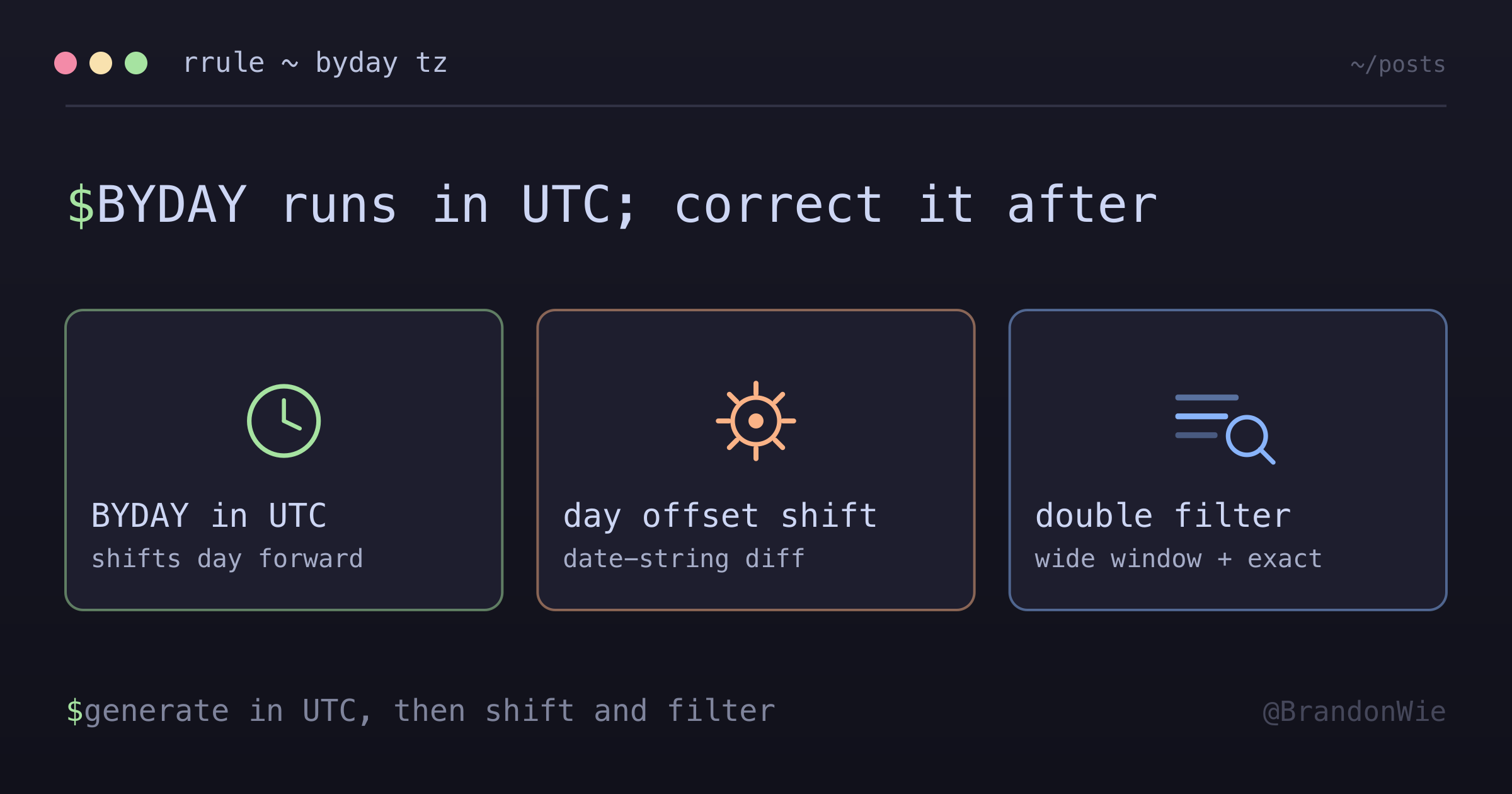
rrule BYDAY Timezone Correction
The rrule JavaScript library interprets `BYDAY` weekday names in UTC, not the event's own timezone.
A weekly event set for Friday 08:00 KST expanded onto Saturday. Friday 08:00 KST is Thursday 23:00 UTC, and when the rrule library expanded the BYDAY=FR rule it read “Friday” as Friday in UTC — generating occurrences at Friday 23:00 UTC, which is Saturday 08:00 KST. Not a few hours off; a whole day off. That is how I found out the rrule JavaScript library does not handle timezones the way its API suggests.
The Problem
The core issue is a mismatch between what the rrule library promises and what it delivers. When you have an event in a timezone ahead of UTC, the date can cross midnight.
| Event Setup | rrule Interpretation | Result |
|---|---|---|
| Friday 08:00 KST (Thu 23:00 UTC) | BYDAY=FR = Friday in UTC | Generates Fri 23:00 UTC = Sat 08:00 KST (WRONG) |
| Expected | BYDAY=FR = Friday in KST | Should generate Thu 23:00 UTC = Fri 08:00 KST |
The library applies the BYDAY constraint in UTC. For users in UTC+N timezones (KST, JST, IST), any event whose local time maps to the previous UTC date gets shifted forward by a day.
Why the “Obvious” Fix Does Not Work
The rrule library accepts a tzid parameter. That looks like the solution — pass tzid: "Asia/Seoul" and let the library handle it. I tried that first.
It does not work. The library has multiple documented issues with timezone handling:
- BYDAY returns wrong days with timezone conversions (GitHub #556)
- Invalid date output when passing tzid (GitHub #523)
- “Pseudo-UTC” dates — the library returns dates that look like UTC (ISO string with
Zsuffix) but are meant to be interpreted in the TZID timezone - TZID ignored in some operations (GitHub #364)
The “pseudo-UTC” behavior is especially treacherous. During debugging, the output looks correct because the timestamps have Z suffixes. You do not notice the problem until you compare against what the actual local time should be.
Four Obstacles I Hit
The tzid option appeared to be the fix. The API surface suggests timezone-aware expansion is built in. Multiple GitHub issues confirmed it is broken, but that was not obvious from reading the docs alone.
“Pseudo-UTC” dates mislead debugging. The library returns dates that look like UTC but are not. This made it seem like the output was correct until I compared against the actual local time.
Month boundary arithmetic trap. My first attempt at calculating the day offset used .date() difference — for example, Feb 1 minus Jan 31 gives -30, not +1. I had to switch to date-string-based comparison to handle month boundaries correctly.
Cross-timezone occurrences fall outside the query period. Events near midnight boundaries were silently excluded because the query window was too tight. I needed to expand the rrule period by +/-1 day as a safety margin.
The Solution: Post-Generation Correction
Since the library cannot handle timezones correctly during generation, the workaround is to let it generate in UTC and then correct the results afterward.
1. Expand rrule period by +/-1 day for BYDAY rules (catch cross-timezone occurrences)
2. Generate occurrences using UTC dtstart (no tzid)
3. Calculate day offset: eventTimezone.date() - UTC.date()
4. Shift all occurrences by negative of day offset
5. Filter by:
   a. Weekday in the event's timezone matches BYDAY values
   b. Occurrence date falls within requested period
The expanded period in step 1 prevents the silent exclusion problem. The day offset in steps 3-4 corrects the weekday shift. The double filter in step 5 ensures only valid occurrences survive.
Day Offset Calculation
This is the core of the correction. The offset tells you how many days the local date differs from the UTC date for the event’s start time.
The snippet below uses dayjs with its utc and timezone plugins, but nothing here is dayjs-specific — any date library that can render a date in a named timezone and diff two dates in whole days works the same way.
// Example: event at Friday 08:00 KST = Thursday 23:00 UTC
const dtstartInEventTz = dayjs.tz(parentStart, timeZone); // Jan 16 (Fri in KST)
const dtstartInUtc = dayjs.utc(parentStart); // Jan 15 (Thu in UTC)

// Use date string comparison to handle month boundaries correctly
// (e.g., Jan 31 UTC -> Feb 1 KST gives +1, not -30)
const localDateStr = dtstartInEventTz.format("YYYY-MM-DD");
const utcDateStr = dtstartInUtc.format("YYYY-MM-DD");
const dayOffset = dayjs.utc(localDateStr).diff(dayjs.utc(utcDateStr), "day"); // 1

// Shift occurrences backward to compensate
// rrule generates: Fri 23:00 UTC (Sat in KST) - WRONG
// After shift: Thu 23:00 UTC (Fri in KST) - CORRECT
The date-string comparison is critical. A naive approach using .date() — the day-of-month integer — breaks at month boundaries. January 31 UTC becomes February 1 KST, and 1 - 31 = -30 instead of the correct +1. By converting to full date strings first and then diffing, we get the correct offset regardless of which month we are in.
Extracting BYDAY Values
To verify that corrected occurrences land on the right weekday, you need to parse the BYDAY values from the rrule string. RFC 5545 allows several formats.
// Captures all valid BYDAY formats per RFC 5545:
// - Simple: MO, TU, WE, TH, FR, SA, SU
// - With ordinal: 1MO (first Monday), -1FR (last Friday), +2TU (2nd Tuesday)
const byDayMatch = rruleString.toUpperCase().match(/BYDAY=([A-Z0-9,+-]+)/);

// Strip numeric prefix to get weekday code
const dayCode = day.replace(/^[+-]?d+/, ""); // "1MO" -> "MO", "-1FR" -> "FR"
The regex handles both simple weekday codes (FR) and ordinal prefixes (1MO, -1FR, +2TU). After stripping the ordinal, you get a clean two-letter day code to compare against the corrected occurrence’s weekday.
Takeaway
The rrule JavaScript library’s tzid option is broken for BYDAY rules. If you are expanding recurring events where the event’s timezone differs from UTC — particularly for UTC+N timezones like KST, JST, or IST where the date crosses midnight — you need post-generation correction.
Three rules I follow now:
- Do not trust library timezone options — verify with tests that cover cross-midnight scenarios
- Use date string comparison for month boundaries — never diff
.date()integers across months - Double filter for safety — filter at expansion time (wider window) AND at final output (exact match)
This workaround is specific to the jkbrzt/rrule JavaScript library. Python’s dateutil.rrule and other implementations may handle timezones correctly. And for non-BYDAY rules like FREQ=DAILY or BYMONTHDAY, the standard rrule expansion works without correction because there is no weekday interpretation involved.