On this page
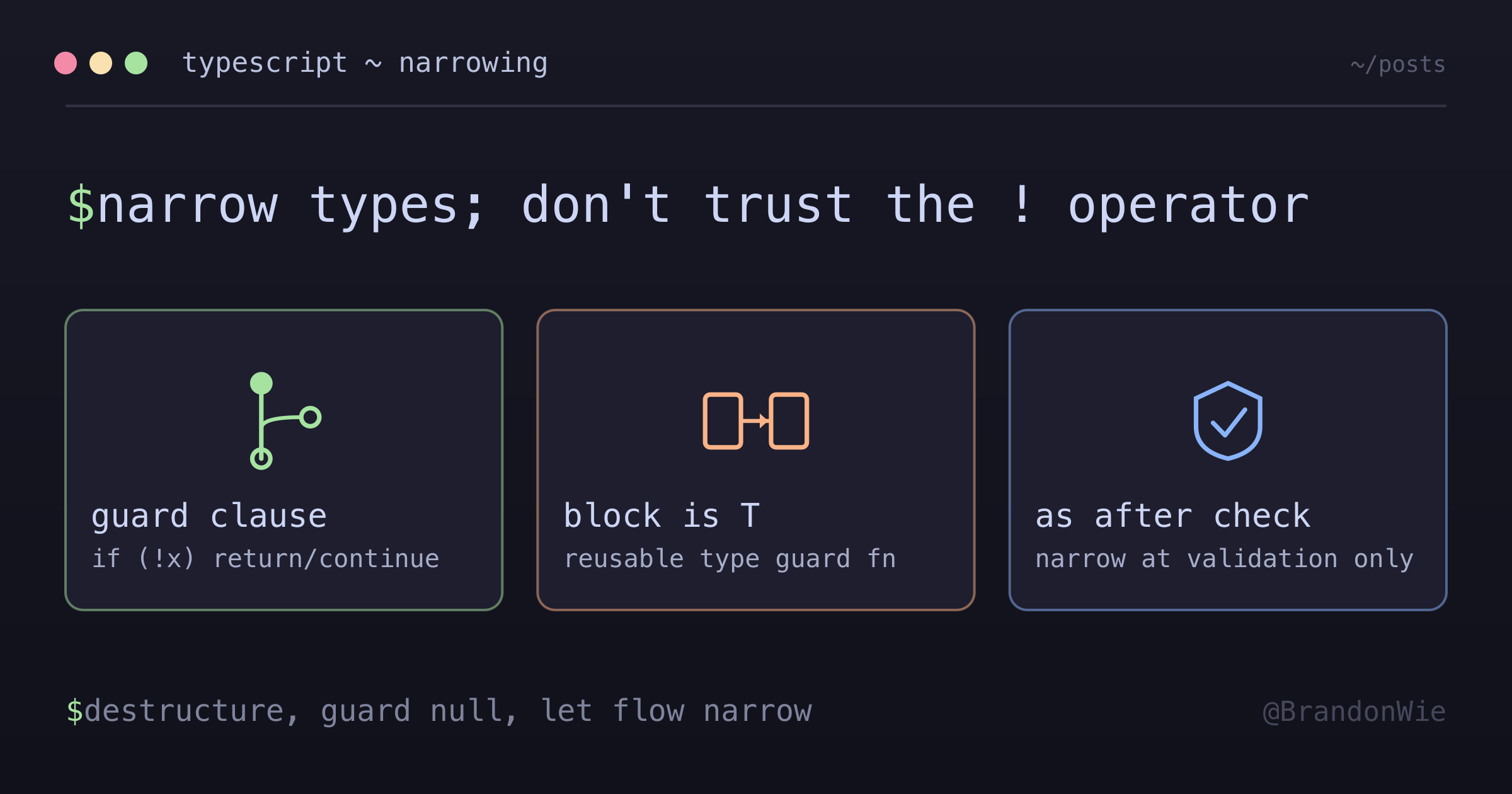
TypeScript Type Narrowing Over Assertions
Prefer type narrowing over non-null assertions (`!`) and forced casting
A stale block cleanup helper I worked on used block.gcalId!, the non-null assertion operator, justified by a comment: “guaranteed non-null by DB query.” The compiler was happy and the code looked clean. What stuck with me is that the comment was the entire guarantee: nothing the compiler could verify, and DB queries do change. I replaced the assertion with a guard clause, and writing this up is mostly an attempt to say why that trade felt worth one extra line.
Non-null assertions (!) and forced casting (as Type) tell TypeScript “trust me, I know better.” They suppress the type error without adding any runtime safety. Type narrowing gives you the compile-time check and the runtime protection, and it usually costs one extra line.
The Problem
Non-null assertions bypass TypeScript’s type checking entirely:
// ❌ BAD: Assumes gcalId exists without runtime check
function processBlock(block: Block) {
  console.log(block.gcalId!.length); // Runtime error if null
}
The ! operator makes the compiler stop complaining, but it doesn’t make the value non-null. If gcalId is ever null or undefined at runtime, you get a TypeError at the access site, usually far from the code that made the assumption.
What bites is the false sense of safety. Comments like “guaranteed non-null by DB query” or “always set by middleware” are promises TypeScript can’t verify, and the things they depend on move. A query gets rewritten, or middleware gets refactored, or a migration hands you a row shaped in a way nobody planned for. The ! operator passes all of that through until it crashes in production.
The Solution
What I do instead is destructure into a local variable and put a guard clause in front of it. TypeScript’s control flow analysis narrows the type from there:
// ✅ GOOD: Runtime check with type narrowing
function processBlock(block: Block) {
  const { gcalId } = block;
  if (!gcalId) return; // or throw, or continue

  console.log(gcalId.length); // TypeScript knows gcalId is string
}
After the guard clause, TypeScript knows gcalId is non-null in the rest of the function. You don’t need an assertion, and you get runtime protection against the edge cases a comment can’t prevent.
Three Narrowing Patterns
1. Early Return / Continue
This is the one I reach for most. In loops it’s continue to skip null entries, in functions an early return:
for (const block of blocks) {
  const { gcalId } = block;
  if (!gcalId) continue;

  // gcalId is guaranteed non-null here
  results.push(gcalId);
}
The part I underestimated is that continue, return, and throw are not interchangeable. Each guard is a decision about what a missing value means: continue skips one item and keeps going, early return abandons the whole call, and throw says the invariant was violated and nothing downstream should proceed. Picking the wrong one fails quietly. A continue where a throw belonged drops data without a sound, and a throw where a continue belonged turns one bad row into a failed batch.
2. Type Guard Function
When you need to narrow a complex type across multiple call sites, extract the check into a reusable type guard:
type BlockWithCalendar = Block & { calendar: Calendar };

function hasCalendar(block: Block): block is BlockWithCalendar {
  return block.calendar !== null;
}

// Usage
if (hasCalendar(block)) {
  console.log(block.calendar.id); // Safe
}
Custom type guards are useful, but they are also boilerplate you have to keep in sync with the type. For a single null check inside one function, a plain if (!x) return is less code and just as safe. The guard function earns its keep when several call sites need the same shape check, or when the narrowed type is an intersection nobody wants to spell out repeatedly.
3. Intersection Type After Validation
At validation boundaries, throw on invalid data and return the narrowed type:
function validateBlock(block: Block): BlockWithCalendar {
  if (!block.calendar) {
    throw new BlockBadRequestException("Calendar is required");
  }
  return block as BlockWithCalendar; // Safe: validated above
}
Note that as Type after explicit validation is fine, since you’ve just verified the invariant on the line above. The problem is as Type without validation.
Real-World Example
That stale block cleanup utility is the concrete case. The original relied on a non-null assertion plus a comment:
// Before (risky):
export function identifyStaleBlockIds(
  existingBlocks: StaleBlockCandidate[],
  googleEventGcalIds: Set<string>
): number[] {
  const staleBlockIds: number[] = [];
  for (const block of existingBlocks) {
    // NOTE: gcalId is guaranteed non-null by DB query
    if (!googleEventGcalIds.has(block.gcalId!)) {
      staleBlockIds.push(block.id);
    }
  }
  return staleBlockIds;
}
The refactored version uses a guard clause instead:
// After (safe):
export function identifyStaleBlockIds(
  existingBlocks: StaleBlockCandidate[],
  googleEventGcalIds: Set<string>
): number[] {
  const staleBlockIds: number[] = [];
  for (const block of existingBlocks) {
    const { gcalId } = block;
    if (!gcalId) continue; // Defensive guard

    if (!googleEventGcalIds.has(gcalId)) {
      staleBlockIds.push(block.id);
    }
  }
  return staleBlockIds;
}
The guard skips blocks with a null gcalId instead of crashing. In production that meant the function kept processing the valid blocks when edge-case data slipped through, rather than taking down the entire sync operation with a TypeError.
Extracting a Guard Can Silently Drop Its Narrowing
Months later, the same codebase turned up a second lesson, this time about the guards themselves. Centralizing duplicated guards is about as routine a refactor as there is: six handlers carried the identical check, so it moved into a helper. What’s easy to miss, because the runtime behavior really is identical, is that the inline version had been doing two jobs at once:
// refuses the enqueue AND narrows both fields to non-null below this line
if (event.integrationId === null || event.calendarGcalId === null) return;
Extracting it to a helper that returns boolean preserved only the first job:
// WRONG — refusal preserved, narrowing lost
private isEnqueueableGoogleEvent(event: {...}): boolean
Every downstream queue.add({ integrationId: event.integrationId }) stopped compiling, because the job payload declares that field as number | undefined and null is not assignable to it. Nothing about the runtime behavior had changed. The refactor was faithful in every way except the one the compiler cared about, and the build broke everywhere.
The fix is a type predicate over a generic parameter, which hands the narrowing back to callers:
private isEnqueueableGoogleEvent<
  TEvent extends { integrationId: number | null; calendarGcalId: string | null },
>(event: TEvent, fnName: string): event is TEvent & {
  integrationId: number;
  calendarGcalId: string;
} {
event is TEvent & {...} is legal because the narrowed type is assignable to the declared parameter type, and if (!pred(x)) return; narrows x for the rest of the function exactly as the inline guard did.
The part I would not have predicted: an inline if (...) return; is a control-flow statement and a type-level statement, while a function returning boolean can only replace the first half. So whenever a nullness or shape check gets lifted out of a function body, it is worth asking whether anything downstream depended on the narrowing. Reaching for a predicate by default seems like the cheaper habit, since it costs nothing when nobody uses the narrowing.
Worth naming honestly: the test suite in that repo could not have caught this, and that is a property of its configuration rather than of test suites in general. ts-jest ran with diagnostics.warnOnly, so a type error downgrades to a warning and the run still goes green, and the diagnostics were scoped to spec files anyway, so type errors in source files never surfaced during a test run at all. ESLint does not type-check either. So “all tests pass, lint clean” was never evidence that this refactor was safe. In that repo, the build was the only gate that could fail on it.
When Assertions ARE Acceptable
Type narrowing isn’t always necessary. These are the cases where ! or as Type holds up:
| Scenario | Allowed | Example |
|---|---|---|
| After explicit validation | Yes | return block as BlockWithCalendar after null check |
| In test files | Yes | expect(result!.id).toBe(1) |
| Type narrowing helpers | Yes | With proper type guards |
| Production code without validation | No | block.gcalId! |
Tests are the main exception. A non-null assertion in a test is fine because the test itself is the safety net: if result is null, the test fails, which is exactly what should happen. Adding narrowing guards to test assertions adds noise without improving safety.
Two more places where the extra guard buys nothing. The first is contexts where the language has already done the narrowing for you. Inside a .filter(Boolean) callback, or after a .find() whose result you have just checked for truthiness, a second guard restates something the compiler already knows. The second is the rare hot path: if a check runs millions of times in an inner loop and the invariant really is guaranteed by construction, ! may be the honest choice. That one comes with a caveat I would apply to myself as much as anyone, because “guaranteed by construction” is the same phrase that produced block.gcalId! in the first place. If I took that route I’d want a comment spelling out what the construction actually guarantees, and I’d expect that comment to be re-checked the next time the construction changes.
Takeaway
Where I’ve landed for production code is to trade ! for a guard clause (if (!x) return/continue/throw): destructure into a local variable, guard against null, and let TypeScript’s control flow narrow the type from there. It’s one extra line, and it buys the compile-time check and the runtime crash prevention together. ! and as Type still earn their place in test files and on the line right after explicit validation. The piece I’d flag hardest is the last one: when a guard moves out of a function body into a shared helper, a type predicate holds up where a boolean doesn’t, because the refusal survives the refactor and the narrowing quietly doesn’t.