On this page
zsh Backtick Evaluation in Claude Code Skills
Claude Code SKILL.md files can trigger zsh command substitution errors when
I was writing a Claude Code SKILL.md file — a markdown document that defines instructions for Claude’s /wrap command. The skill worked fine on my colleague’s machine. On mine, every invocation printed two lines of errors to stderr before doing anything useful:
(eval):1: command not found: fixed
(eval):2: command not found: 3.
The errors were non-fatal. The skill still ran. But “non-fatal stderr noise on every invocation” is the kind of thing that erodes trust in tooling. I spent an hour tracking down the cause, and the answer was not where I expected.
The Culprit: Markdown Backticks Meet zsh
The problem was in the SKILL.md file itself. Claude Code processes skill files through a pipeline that, at some point, passes the content through zsh’s eval builtin. That means anything in the markdown that looks like shell syntax gets interpreted as shell syntax.
Here is the line that broke:
entry type: `+` (added), `~` (changed),
   `-` (removed), `!` (fixed)
3. Add entry to `{PATH}/CHANGELOG.md`:
To a markdown renderer, those backticks are inline code formatting. To zsh, they are command substitution delimiters.
How zsh Parses This
The shell pairs backticks and tries to execute whatever is between them. Here is what zsh sees:
- The backtick before
+opens a command substitution - The backtick after
+closes it — zsh tries to execute+, which is not a command but happens to not error - The next backtick before
~opens another substitution - The backtick after
~closes it - When it hits
`!` (fixed), zsh interprets(fixed)after the backtick-close as a subshell command - The
(eval)prefix in the error message confirms this: zsh’s eval builtin is processing the text
The second error, command not found: 3., comes from the next line. After the backtick pairing goes wrong, 3. Add entry to gets interpreted as a command named 3..
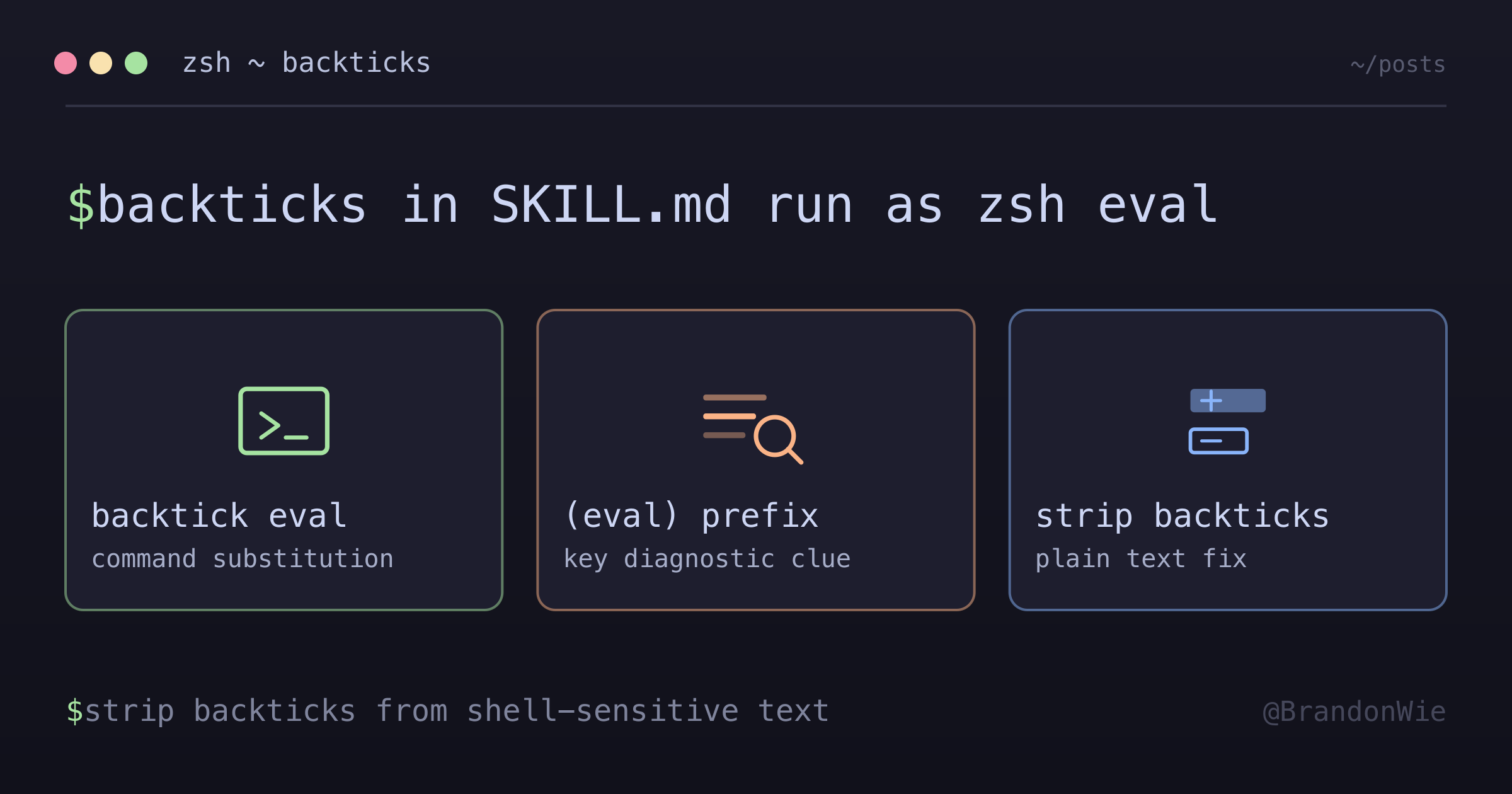
The (eval) prefix in the error messages is the key diagnostic clue. It tells you that zsh’s eval builtin is processing the text, not the regular shell parser. This narrows the search: something is passing your markdown content to eval.
Why This Only Affects Some Machines
This bug is shell-specific. If your default shell is bash, backticks inside eval behave differently — bash is more lenient about what constitutes a valid command substitution in certain contexts. The error surfaces on zsh, which is the default shell on macOS since Catalina. So a SKILL.md file that works fine on a Linux CI server with bash will break on a developer’s MacBook.
The Fix
Remove backtick formatting from text that contains shell-sensitive characters. The content does not need inline code styling to be readable.
# Before (breaks in zsh)
`!` (fixed)

# After (works everywhere)
fixed = !
The general rule: avoid backtick-wrapping characters like !, $, (, ) when followed by text that could be interpreted as shell syntax. In a SKILL.md file, plain text communicates the same information without triggering the shell parser.
If you need to preserve the formatting, consider restructuring the content so that backtick pairs do not surround shell-sensitive characters. For example, instead of `!` (fixed), write type "!" means fixed. The goal is to break the pattern that zsh recognizes as command substitution.
Diagnosing Similar Issues
If you see (eval):N: command not found errors in Claude Code, check these things:
- Look for backtick pairs in your SKILL.md files that surround characters with shell meaning (
!,$,(),{}) - Check if the error text matches content in your skill file — the “command not found” string will be a word from your markdown
- Verify your shell — run
echo $SHELLto confirm you are on zsh - Test with bash — if the error disappears under
bash -c, the issue is zsh-specific backtick handling
Takeaway
When writing SKILL.md files for Claude Code, treat the content as shell-adjacent text, not pure markdown. Backticks are not safe formatting — they are command substitution delimiters that zsh will try to evaluate. Strip backtick formatting from any text that contains shell-meaningful characters. The errors are non-fatal, but eliminating them means one less thing to investigate when something else goes wrong.